What Is an Absorbable Tacker Used for in Surgery?
Modern surgical procedures increasingly use minimally invasive techniques to reduce tissue trauma, improve procedural efficiency and support faster patient recovery. During many hernia repair procedures, surgeons place a surgical mesh over weakened tissue to reinforce the affected area.
For the mesh to function effectively, it must remain properly positioned while surrounding tissue heals and integrates with it. An absorbable tacker is a specialised surgical fixation device used to secure surgical mesh to soft tissue during open or laparoscopic procedures.
Its most common application is mesh fixation during hernia repair surgery.
What Is an Absorbable Tacker?
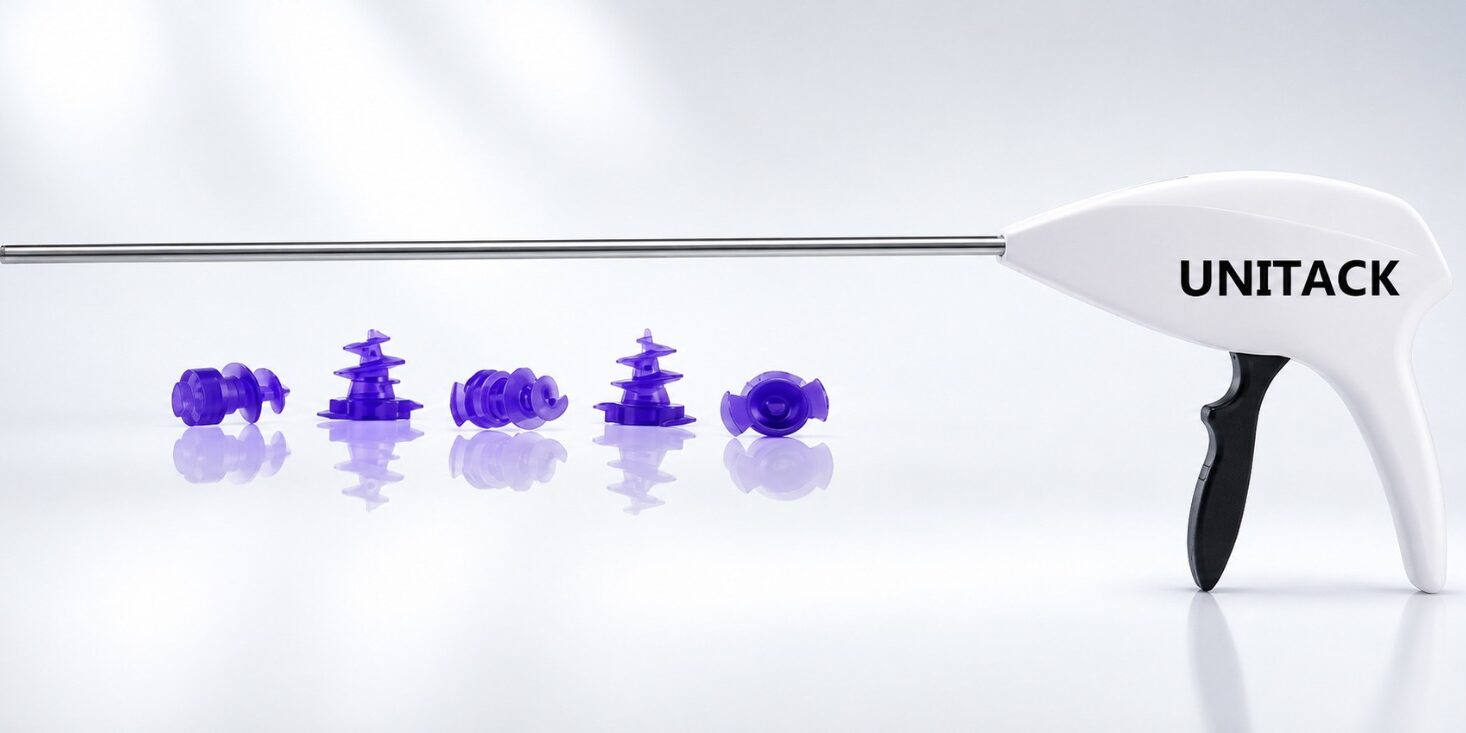
An absorbable tacker is a sterile surgical device preloaded with multiple absorbable fasteners, commonly known as tacks.
The device generally consists of:
• An ergonomic handle
• A long, narrow shaft
• A controlled trigger mechanism
• A specialised deployment tip
• Preloaded absorbable tacks
When the surgeon activates the trigger, the device deploys a tack through the surgical mesh and into the underlying tissue. This creates temporary mechanical fixation that helps keep the mesh in its intended position.
Unlike permanent metallic fasteners, absorbable tacks are manufactured from biocompatible materials designed to gradually degrade inside the body after completing their fixation function.
What Is the Primary Use of an Absorbable Tacker?
The primary use of an absorbable tacker is to secure prosthetic surgical mesh to soft tissue during hernia repair surgery.
A hernia develops when an internal organ or tissue pushes through a weak area in the surrounding muscle or connective tissue. During mesh-based hernia repair, a surgical mesh is positioned over or behind the defect to strengthen the weakened abdominal wall.
The absorbable tacker helps to:
• Secure the mesh to surrounding tissue
• Maintain the correct mesh position
• Reduce the risk of mesh folding or displacement
• Provide temporary support during healing
• Facilitate mesh fixation through laparoscopic access
The number and placement of tacks depend on the surgical technique, mesh design, tissue condition and anatomical location.
How Does an Absorbable Tacker Work?
During surgery, the surgeon first positions the mesh over the hernia defect with adequate coverage of the weakened area.
The tip of the absorbable tacker is then placed against the selected fixation point. When the trigger is activated, an absorbable tack passes through the mesh and anchors it to the underlying soft tissue.
The process usually involves the following steps:
- The surgical mesh is positioned over the defect.
- The tacker is introduced into the surgical area.
- The deployment tip is placed against the mesh.
- The surgeon activates the trigger.
- The tack penetrates the mesh and engages the tissue.
- Additional tacks are deployed at selected fixation points.
The tacks provide mechanical support during the early healing period. Over time, the absorbable material gradually breaks down through natural biological processes.
Why Is Mesh Fixation Important in Hernia Surgery?
Correct mesh positioning is essential for effective reinforcement of the hernia defect.
If the mesh moves, folds or wrinkles before tissue integration occurs, it may not provide consistent coverage of the weakened area. Secure fixation helps maintain the desired mesh orientation during the critical healing period.
Proper mesh fixation may support:
• Stable mesh placement
• Adequate coverage of the hernia defect
• Controlled mesh positioning
• Better procedural consistency
• Early tissue integration
• Efficient laparoscopic deployment
The surgeon determines the appropriate fixation pattern based on the type of hernia and the selected surgical approach.
Common Surgical Applications of Absorbable Tackers
Laparoscopic Hernia Repair
Absorbable tackers are commonly used during laparoscopic hernia repair. Their long and narrow shaft allows them to pass through a compatible trocar and reach the internal surgical site.
This enables surgeons to fix the mesh through relatively small incisions.
Inguinal Hernia Repair
In selected inguinal hernia procedures, absorbable tacks may be used to secure the surgical mesh in the intended position.
Placement must be carefully planned because of the surrounding nerves, vessels and anatomical structures.
Ventral Hernia Repair
Absorbable tackers may be used during ventral hernia repair to create multiple fixation points around the mesh.
These fixation points help maintain appropriate mesh overlap across the abdominal wall defect.
Incisional Hernia Repair
An incisional hernia can develop around the site of a previous surgical incision. Mesh reinforcement may be required, and absorbable tacks can assist with temporary mesh-to-tissue fixation.
Open Surgical Procedures
Certain absorbable fixation systems may also be used in suitable open procedures for mesh fixation or soft-tissue approximation, depending on the approved indications of the device.
Benefits of Using an Absorbable Tacker
Temporary Mechanical Support
Absorbable tacks provide fixation during the healing phase and gradually degrade after completing their intended function.
Minimally Invasive Application
The device can be introduced through a laparoscopic port, supporting mesh fixation through smaller surgical incisions.
Controlled Tack Deployment
The trigger mechanism allows the surgeon to deploy individual tacks at carefully selected locations.
Efficient Mesh Fixation
Multiple fixation points can be created without tying individual sutures at every location, which may improve procedural efficiency.
No Permanent Metallic Fasteners
Absorbable tacks are designed to degrade over time and therefore do not remain permanently as metallic implants.
Precise Surgical Placement
The specialised applicator allows surgeons to position each tack according to the required fixation pattern.
Absorbable Tacker vs Permanent Tacker
Both absorbable and permanent tackers are used for surgical mesh fixation. The primary difference is the material from which the fasteners are manufactured.
Permanent tackers generally deploy metallic fasteners that remain in the body indefinitely.
Absorbable tackers deploy polymer-based fasteners that gradually lose strength and degrade after implantation.
The choice between absorbable tacks, permanent tacks, sutures, adhesives or self-fixating mesh depends on several factors, including:
• Type and location of the hernia
• Surgical approach
• Mesh design
• Tissue quality
• Required fixation duration
• Surgeon’s preferred technique
No single fixation method is appropriate for every surgical situation.
What Materials Are Used in Absorbable Tacks?
Absorbable tacks are commonly manufactured from biocompatible polymers designed to gradually break down inside the body.
UNITACK Absorbable Tacker from Universal Sutures uses absorbable fasteners manufactured from a lactide and glycolide copolymer, commonly known as PLGA.
After implantation, PLGA gradually degrades into lactic acid and glycolic acid. These substances are then processed through the body’s natural metabolic pathways.
This allows the fasteners to provide temporary fixation during healing without remaining permanently at the surgical site.
UNITACK Absorbable Tacker by Universal Sutures
UNITACK Absorbable Tacker from Universal Sutures is designed for fixing prosthetic material to soft tissue during appropriate open and laparoscopic surgical procedures.
Its design supports:
• Controlled tack deployment
• Accurate mesh positioning
• Reliable temporary fixation
• Efficient laparoscopic application
• Absorbable PLGA-based fasteners
• Convenient mesh-to-tissue attachment
UNITACK provides surgeons with a practical fixation solution when temporary support is required during tissue healing and mesh integration.
Important Surgical Considerations
Absorbable tackers are specialised surgical devices intended for use by trained healthcare professionals.
Before deploying a tack, the surgeon must consider:
• Tissue thickness and strength
• Mesh characteristics
• Fixation depth
• Nearby nerves and blood vessels
• Underlying organs and structures
• Required spacing between fixation points
• Product compatibility
• Approved indications and contraindications
Careful placement is essential because each tack mechanically penetrates the mesh and underlying tissue.
Conclusion
An absorbable tacker is primarily used to secure surgical mesh to soft tissue during open or laparoscopic hernia repair surgery.
It provides temporary mechanical fixation that helps maintain the mesh in the correct position while tissue healing and integration take place. The absorbable fasteners gradually degrade after completing their fixation role, reducing the need for permanent metallic tacks.
UNITACK Absorbable Tacker from Universal Sutures combines absorbable PLGA fasteners with a controlled deployment system designed to support efficient mesh fixation, accurate positioning and dependable surgical performance.