Hernia mesh is a medical implant used to reinforce weakened tissue during hernia repair. It provides additional support to the abdominal wall and helps maintain the repair while the surrounding tissue heals and integrates with the mesh.
However, surgical meshes are not all manufactured from the same material or designed in the same shape. The appropriate mesh may vary depending on the type of hernia, location of the defect, surgical technique, required duration of support and whether the mesh will be placed near internal organs.
This guide explains the different kinds of hernia mesh material used in surgery, including polypropylene mesh, partially absorbable mesh, composite mesh and specially shaped mesh products available from Universal Sutures.
Material and Design Are Two Different Factors
When comparing surgical mesh products, it is important to distinguish between:
- Mesh material: The polymer or combination of polymers used to manufacture the mesh
- Mesh design: The size, pore structure, weight and shape of the mesh
- Absorption profile: Whether the mesh remains permanently or contains an absorbable component
- Application: The type of hernia or surgical procedure for which the product is designed
For example, plug mesh and keyhole mesh are primarily design configurations. Both may be manufactured from polypropylene, but their shapes are created for different anatomical locations and surgical requirements.
1. Non-Absorbable Polypropylene Mesh
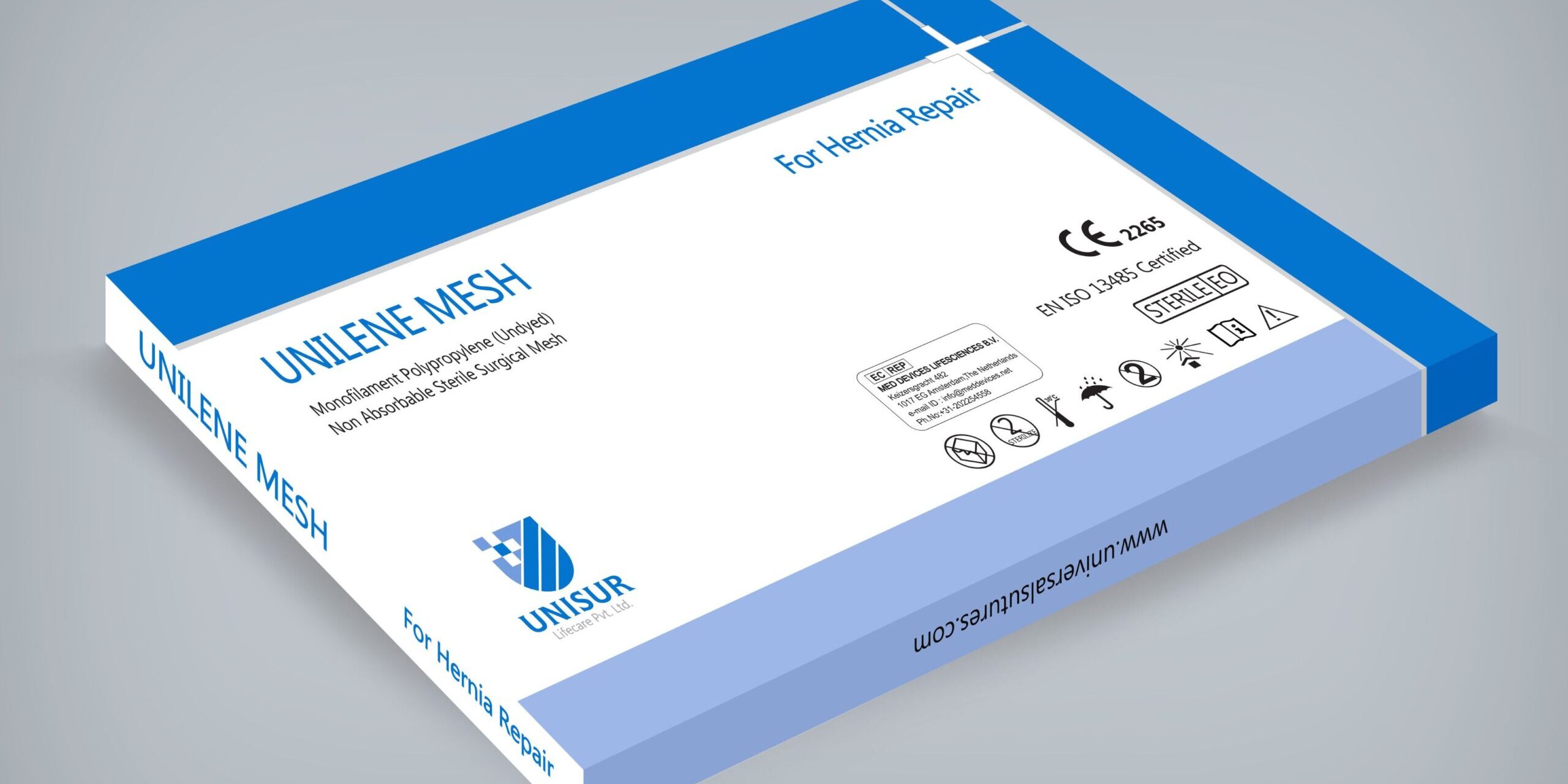
Polypropylene is one of the most widely used materials in surgical mesh manufacturing. It is a synthetic, non-absorbable polymer that remains in the body to provide long-term tissue reinforcement.
Monofilament polypropylene mesh is generally designed to be:
- Lightweight and flexible
- Biologically inert
- Resistant to degradation by tissue enzymes
- Suitable for tissue integration
- Capable of providing permanent mechanical support
Universal Sutures manufactures polypropylene mesh in different dimensions, knitting patterns, pore sizes, thicknesses and shapes for open and laparoscopic hernia repair procedures.
Polypropylene mesh may be used for:
- Inguinal hernia repair
- Umbilical hernia repair
- Ventral hernia repair
- Incisional hernia repair
- Abdominal wall reinforcement
The final product selection should be made by the surgeon according to the defect size, placement technique, tissue quality and individual patient requirements.
2. Partially Absorbable Mesh
Partially absorbable mesh combines a permanent material with an absorbable component. The absorbable portion gradually breaks down after implantation, while the non-absorbable structure remains to provide long-term reinforcement.
Universal Sutures offers partially absorbable mesh manufactured using:
- Non-absorbable polypropylene monofilament
- Absorbable poly(glycolide-co-caprolactone) monofilament
The absorbable component is designed to be absorbed over time, reducing the amount of permanent material remaining in the body, while the polypropylene structure continues to support the repaired tissue.
Potential product characteristics include:
- Reduced mesh weight after absorption
- Flexible and elastic construction
- Long-term support from the polypropylene component
- Handling characteristics suitable for surgical placement
- Tissue integration through the knitted mesh structure
Partially absorbable mesh may be considered for inguinal, ventral, incisional and umbilical hernia repairs, depending on the surgeon’s assessment and approved product indications.
3. Composite Mesh
Composite mesh is manufactured using two or more materials or functional layers. One side may be designed to support tissue integration, while another layer may act as a barrier where the mesh could come into contact with internal organs.
The Universal Sutures Composite Mesh range includes different material constructions developed for soft-tissue reinforcement and hernia repair.
Examples of composite mesh materials include:
Polypropylene and absorbable polymer composite
This type combines permanent polypropylene with an absorbable polymer. The polypropylene provides continuing mechanical support, while the absorbable portion gradually breaks down after implantation.
Polyester and polyethylene composite
This construction may include a polyester mesh layer that supports tissue ingrowth and a low-porosity polyethylene barrier layer designed to limit direct tissue attachment on the barrier-facing side.
Universal Sutures describes its polyester-polyethylene composite mesh as a sterile, non-absorbable product intended for soft-tissue reconstruction, including hernia and chest-wall defect repair. The product combines polyester monofilament with a polyethylene film.
Composite meshes may be considered when:
- The mesh is positioned close to abdominal organs
- A tissue-separating barrier is required
- Laparoscopic placement is planned
- Long-term reinforcement and controlled tissue interaction are needed
The orientation of a composite mesh is important because different surfaces may perform different functions. Surgeons should always follow the approved instructions for use.
4. Plug Mesh or Flower Mesh
A Plug Mesh, also known as Flower Mesh, is a specially shaped polypropylene mesh designed primarily for inguinal hernia repair.
Its flower-like configuration is intended to conform to the hernia defect and reinforce the weakened area. The mesh is placed at the defect site and secured according to the selected surgical technique.
Key characteristics include:
- Biocompatible polypropylene construction
- Lightweight and flexible structure
- Shape designed to conform to the defect
- Support for tension-free hernia repair
- Mesh structure that permits tissue ingrowth
Universal Sutures states that its Plug Mesh is designed particularly for inguinal hernia repair through an anterior approach and provides abdominal-wall reinforcement as the surrounding tissue integrates with the mesh.
5. Keyhole Mesh
A Keyhole Mesh is another pre-shaped polypropylene mesh. It includes a central opening or slit that allows the mesh to be positioned around an anatomical structure.
This configuration may be used in:
- Umbilical hernia repair
- Epigastric hernia repair
- Incisional hernia repair
- Trocar-site hernia closure
- Selected open or laparoscopic procedures
The keyhole design is intended to provide reinforcement around the defect while allowing the mesh to fit around structures such as the umbilical stalk or a trocar site.
Universal Sutures manufactures its Keyhole Mesh from lightweight, biocompatible polypropylene. The product is designed to provide circumferential reinforcement, support tissue integration and reduce the possibility of displacement.
6. U-Sling Prosthesis: A Related Polypropylene Mesh Product
The U-Sling Prosthesis is a specialized polypropylene mesh product, but it is not primarily a hernia-repair mesh.
It is designed for the surgical management of female stress urinary incontinence associated with urethral hypermobility or intrinsic sphincter deficiency.
The prosthesis is manufactured from non-absorbable monofilament polypropylene mesh and may include protective sheaths and preassembled loop sutures to support placement. It can be used through retropubic transvaginal or trans-obturator surgical approaches.
It is included in the wider Universal Sutures mesh portfolio because it demonstrates how polypropylene mesh can be adapted for different soft-tissue and pelvic-floor applications.
How Is the Appropriate Hernia Mesh Selected?
There is no single mesh material that is appropriate for every hernia repair. Selection depends on several clinical and procedural factors.
Type of hernia
Inguinal, ventral, incisional, umbilical and epigastric hernias may require different mesh dimensions and configurations.
Surgical technique
Open, laparoscopic and robotic procedures can involve different placement and fixation requirements.
Anatomical position
A mesh placed away from internal organs may have different material requirements from a mesh positioned within the abdominal cavity.
Permanent or partially absorbable support
The surgeon must determine whether permanent reinforcement or a combination of permanent and absorbable materials is appropriate.
Mesh shape and size
Regular sheets, flower-shaped plugs and keyhole designs are created for different defects and anatomical structures.
Handling and fixation
Flexibility, pore structure, edge design and compatibility with sutures or mesh tackers may influence surgical handling.
Order Surgical Mesh Products from Universal Sutures
Universal Sutures provides a range of surgical mesh products for hospitals, surgeons, distributors, importers and healthcare organisations.
The available portfolio includes:
- Polypropylene surgical mesh
- Partially absorbable mesh
- Composite mesh
- Plug or flower mesh
- Keyhole mesh
- U-Sling prosthesis
- Customized mesh sizes and configurations
Customers may contact Universal Sutures for product specifications, quotations, distributor enquiries, bulk requirements, export supply and technical documentation.
When requesting a quotation, provide the required product type, dimensions, quantity, country and organisation details so the sales team can recommend the appropriate available configuration.
Conclusion
The different kinds of hernia mesh material used in surgery include permanent polypropylene mesh, partially absorbable polypropylene-polymer mesh and multilayer composite mesh made with materials such as polyester and polyethylene.
In addition to material composition, the shape of the mesh also matters. Plug mesh and keyhole mesh are specially designed configurations intended for particular defect locations and surgical approaches.
Understanding the difference between mesh material, absorption profile and product design can help healthcare buyers and professionals evaluate available options more accurately. The final product and surgical technique must always be selected by a qualified surgeon according to the patient’s condition and the approved instructions for use.
Medical disclaimer: This content is intended for general educational and product-information purposes. It does not replace professional medical advice, approved product documentation or the clinical judgement of a qualified healthcare professional.
SEO meta title: Different Kinds of Hernia Mesh Material Used in Surgery
Meta description: Learn about polypropylene, partially absorbable, composite, plug and keyhole mesh materials used in hernia surgery. Explore surgical mesh solutions from Universal Sutures.
Suggested URL slug: /different-kinds-hernia-mesh-material-used-surgery/