
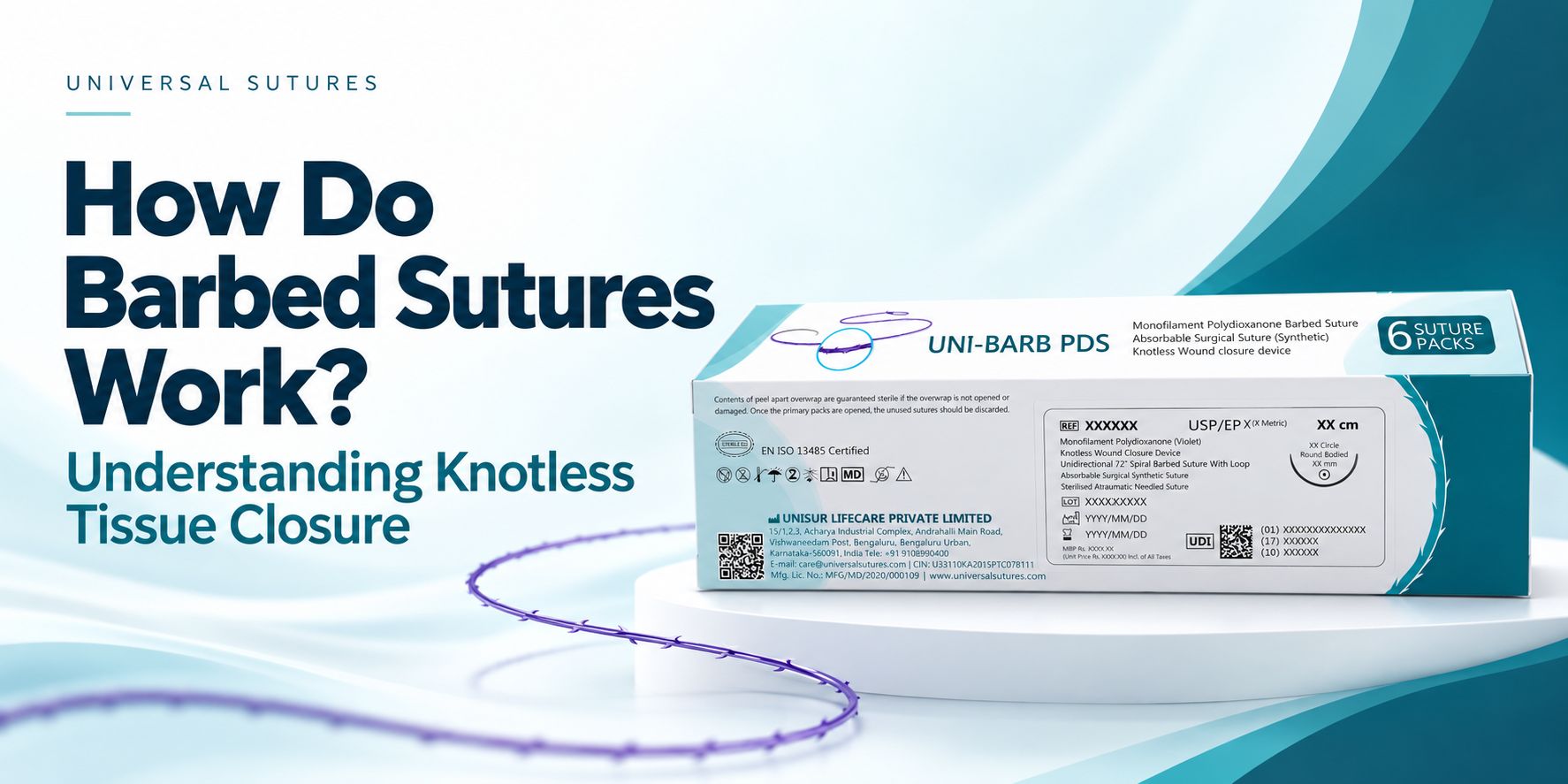
Bringing tissue edges together is a central part of surgical wound closure. Conventional sutures usually rely on knots to secure the thread, while barbed sutures use small projections along their surface to engage tissue and resist backward movement.
A Polydioxanone Barbed Suture combines this tissue-holding design with an absorbable monofilament material, offering an option for suitable soft tissue closure procedures.
But how does a thread stay in place without conventional knots? Understanding the relationship between the barbs, tissue engagement, and suture material explains how knotless closure works.
What Are Barbed Sutures?
Barbed sutures are surgical threads with small, deliberately formed projections called barbs. These projections engage the surrounding tissue as the suture is positioned.
The defining difference is how the thread maintains its position. With a conventional smooth suture, knots help secure the closure. With a barbed design, tissue engagement along the thread helps resist slippage and maintain approximation—the positioning of tissue edges close together.
Barb geometry matters. The depth, angle, and size of each projection influence tissue-holding performance and the strength of the remaining suture core. This makes barbed sutures purpose-designed closure devices rather than ordinary threads with a rough surface.
How Do Barbed Sutures Work?
The mechanism involves three connected functions.
1. The Barbs Engage Tissue
As the suture passes through tissue in its intended direction, the barbs engage the surrounding tissue. Their orientation helps resist movement in the reverse direction.
This creates multiple holding points along the suture line. The thread can therefore help retain the position established during closure.
2. Tissue Engagement Helps Maintain Approximation
During a continuous closure, the surgeon brings the tissue edges together. The engaged barbs help maintain that approximation as suturing progresses.
A published robotic surgery case series described how a self-fixing barbed suture maintained tension without repeated retraction of the thread. This illustrates why the design can be useful when managing a continuous suture line.
3. The Device Provides Knotless Fixation
A suitable barbed closure system uses its anchoring design and tissue engagement to secure the suture line without conventional knot tying.
The starting and finishing methods depend on the specific device. “Knotless” describes the fixation approach; it does not mean that every barbed suture has the same design or can be used with the same technique.
What Role Does Polydioxanone Play?
The barbs explain how the suture holds tissue, while the material determines its absorption and strength-retention characteristics.
Polydioxanone is a synthetic absorbable material. In a monofilament suture, it forms a single strand. A polydioxanone barbed suture gradually loses tensile strength and is absorbed over time.
Strength retention and complete absorption are different milestones. A suture may remain in the body after its useful mechanical support has substantially decreased. Selection should therefore consider the specific product’s strength-retention profile and the tissue’s support requirements, rather than absorption time alone.
Potential Benefits of Knotless Tissue Closure
Less Knot-Tying During Closure
Removing conventional knot-tying steps can simplify parts of the suturing workflow. The practical benefit depends on the procedure, device, and surgeon’s familiarity with the system.
Support Along the Suture Line
Multiple tissue-engagement points help distribute tension along the closure. This supports tissue approximation as the surgeon progresses, although consistent placement and appropriate tension remain essential.
Easier Thread Management in Selected Procedures
Maintaining thread tension can be demanding in minimally invasive surgery. A self-fixing design can reduce the need for repeated thread retraction, as described in the robotic surgery case series.
These advantages should be assessed for the intended procedure. That case series had no control group and could not establish an advantage in time or cost over conventional sutures.
Where Are Polydioxanone Barbed Sutures Used?
Universal Sutures lists general surgery and gynecological surgery among the applications for its monofilament polydioxanone barbed suture.
However, a surgical specialty is broader than a product indication. Suitability for a particular tissue, closure layer, or procedure must be checked against the exact product’s approved instructions for use. Findings involving one barbed suture should not automatically be applied to another.
Important Considerations
Barbed sutures require device-specific training and handling. Clinicians should consider:
- The tissue type and duration of support required.
- The product’s approved indications and limitations.
- Its anchoring and finishing requirements.
- The management of exposed suture ends.
Exposed barbed ends can engage nearby structures. Manufacturer warnings for some devices describe bowel obstruction associated with unintended attachment to bowel or mesentery. Following the applicable instructions for end management is therefore an important part of safe use.
Frequently Asked Questions
Do barbed sutures need knots?
Devices designed for knotless closure use tissue-engaging barbs and an anchoring system in place of conventional knots. The exact method is product-specific.
Are all barbed sutures absorbable?
No. Both absorbable and non-absorbable barbed devices are available. Polydioxanone barbed sutures belong to the absorbable category.
Are barbed sutures better than conventional sutures?
The appropriate choice depends on the tissue, procedure, support requirements, and available evidence. Knotless fixation offers practical advantages in selected settings, but it does not establish universal superiority.
Choosing a Suitable Closure Solution
Barbed sutures work by engaging tissue at multiple points and resisting backward movement, allowing suitable devices to maintain approximation without conventional knots. Polydioxanone adds an absorbable material option to this design.
For product specifications and available configurations, contact Universal Sutures. Clinical selection should follow the product’s approved instructions and the requirements of the planned procedure.