Controlling bleeding is a central part of surgical care. Even after a surgeon has addressed the main bleeding vessels, persistent oozing from smaller vessels or tissue surfaces may require additional attention.
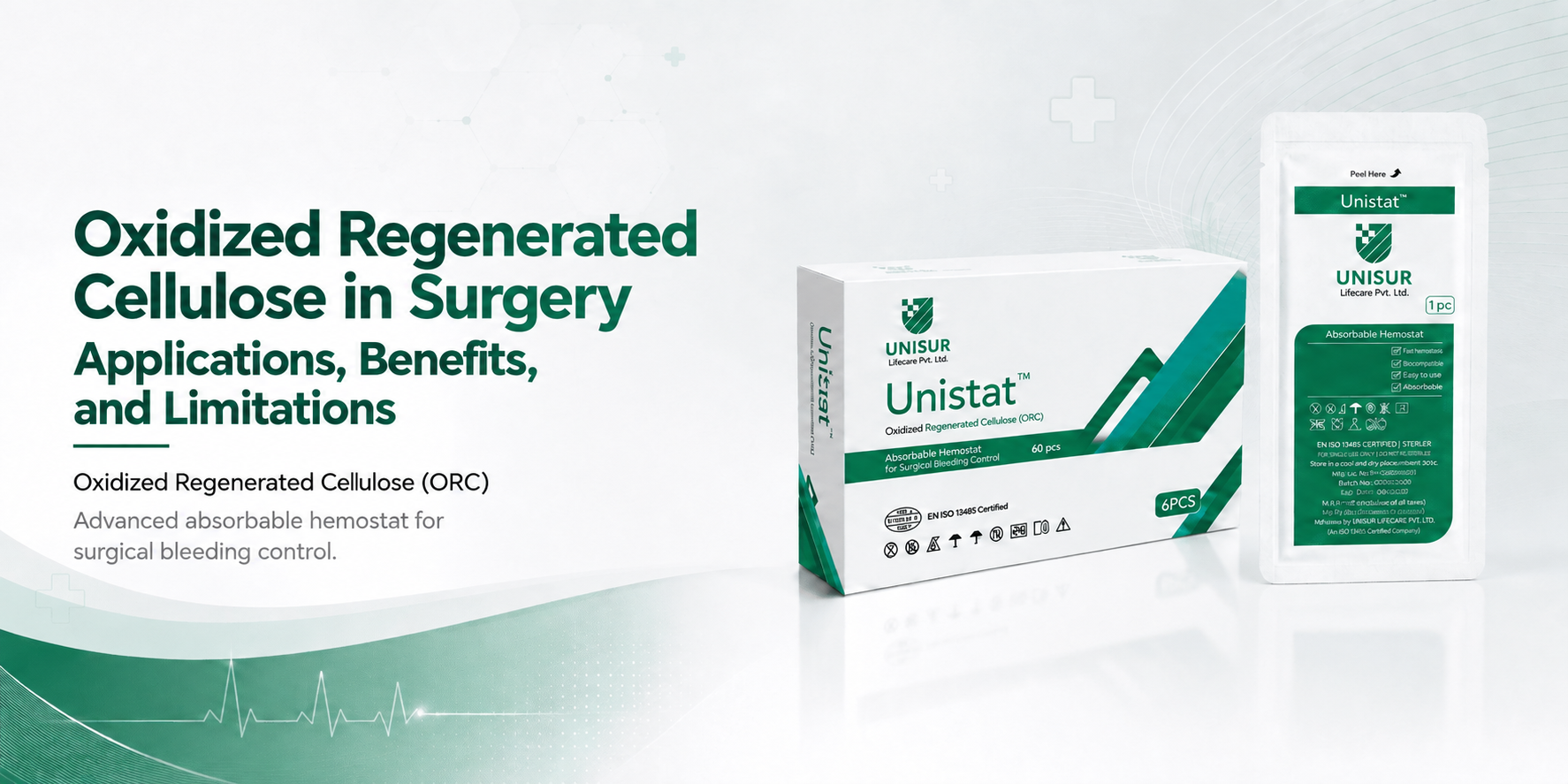
Oxidized regenerated cellulose (ORC) is an absorbable topical hemostatic material used to support bleeding control when conventional methods are ineffective or impractical. Understanding its applications, benefits, and limitations helps healthcare professionals assess where it fits within a surgical hemostasis strategy.[1]
What Is Oxidized Regenerated Cellulose?
ORC is a cellulose-based material processed for use as a surgical hemostat. It is placed at an appropriate bleeding site to assist local hemostasis.
The term “absorbable” describes the material’s ability to break down within the body. However, it does not mean that every application should be left in place. Retention and removal decisions depend on the product instructions and surgical circumstances.[2]
How Does ORC Support Hemostasis?
ORC provides a local material structure that supports clot formation. Contact with blood produces a gelatinous mass, while its acidic properties contribute to its hemostatic action.[1,3]
Laboratory research has also demonstrated antibacterial activity in tested oxidized cellulose products. This finding should be interpreted carefully: laboratory antibacterial activity does not establish that a product prevents surgical-site infections in patients.[4]
For surgical teams, the practical question is whether a particular ORC product is appropriate for the bleeding pattern, tissue surface, and surrounding anatomy.
Applications of Oxidized Regenerated Cellulose in Surgery
General Surgery
ORC may assist with capillary and venous oozing from surgical tissue surfaces. It can be considered as an adjunct where conventional bleeding-control methods are difficult to apply or have not provided adequate control.[1,2]
Cardiovascular Surgery
Universal Sutures identifies cardiovascular surgery among the applications for its ORC product. Suitability depends on the bleeding site and the product’s instructions. Bleeding from a major vessel requires appropriate definitive control.[1,2]
Neurosurgery
Neurosurgery is another application listed by Universal Sutures. In this setting, proximity to sensitive structures makes swelling particularly relevant. ORC use near nerves or within confined spaces requires careful attention to product-specific restrictions and removal requirements.[1,2]
Other Surgical Specialties
Clinical research has examined ORC use across multiple surgical departments. However, evidence involving one manufacturer’s formulation cannot automatically establish equivalent performance for another product. The selected device’s labeling remains essential when assessing a proposed application.[3]
Benefits of ORC as a Surgical Hemostat
Local Support for Persistent Oozing
ORC can complement a surgeon’s primary bleeding-control techniques by addressing suitable areas of residual oozing. Its role is adjunctive, and its usefulness depends on the clinical situation.[2]
Adaptability to Tissue Surfaces
A conformable material can be useful when the treatment area has an irregular shape. The ability to position an appropriate format at the bleeding site is an important consideration during product selection.[1,3]
Absorbable Material
Absorbability is a useful material characteristic, but it must be considered alongside the quantity used, the application site, and the instructions governing removal. It is not a guarantee of complication-free retention.[2]
Choice of Formats
ORC products are available in different structures. Research comparing oxidized cellulose materials shows why manufacturing and material characteristics matter; products should not be treated as interchangeable solely because they belong to the same broad category.[3,4]
Limitations and Precautions
Understanding ORC’s limitations is as important as understanding its benefits.
- Major bleeding needs definitive control. ORC does not replace appropriate suturing, ligation, or other necessary surgical measures.
- Swelling can affect nearby structures. Expansion may create unwanted pressure around nerves, vessels, or confined anatomical spaces.
- Retained material may cause complications. Foreign-body reactions and appearances that complicate postoperative imaging have been reported with ORC hemostats.
- Antibacterial activity has limits. It does not replace indicated antimicrobial prophylaxis or treatment.
- Compatibility requires checking. The acidic environment of certain ORC products can interfere with thrombin activity.
These are considerations described in established ORC product information. Exact contraindications, application methods, and removal requirements must be checked against the instructions for the product being used.[2]
Oxidized Regenerated Cellulose from Universal Sutures
Universal Sutures offers ORC within its hemostasis range. Its product page describes an absorbable, warp-knitted fabric and lists Original, Fabric, Fibrillar, and Non-Woven models.
The published specifications include gamma sterilization, individual aluminium-foil packaging with a secondary carton, and a three-year shelf life when packaging remains intact and storage conditions are appropriate.[1]
For hospitals and distributors, product evaluation should include more than the material name. Request the current instructions for use, model specifications, available sizes, storage requirements, and relevant regulatory documentation. This helps connect procurement decisions with the requirements of the surgical team.
Explore Oxidized Regenerated Cellulose from Universal Sutures for product details, or contact the team to discuss specifications and supply requirements.